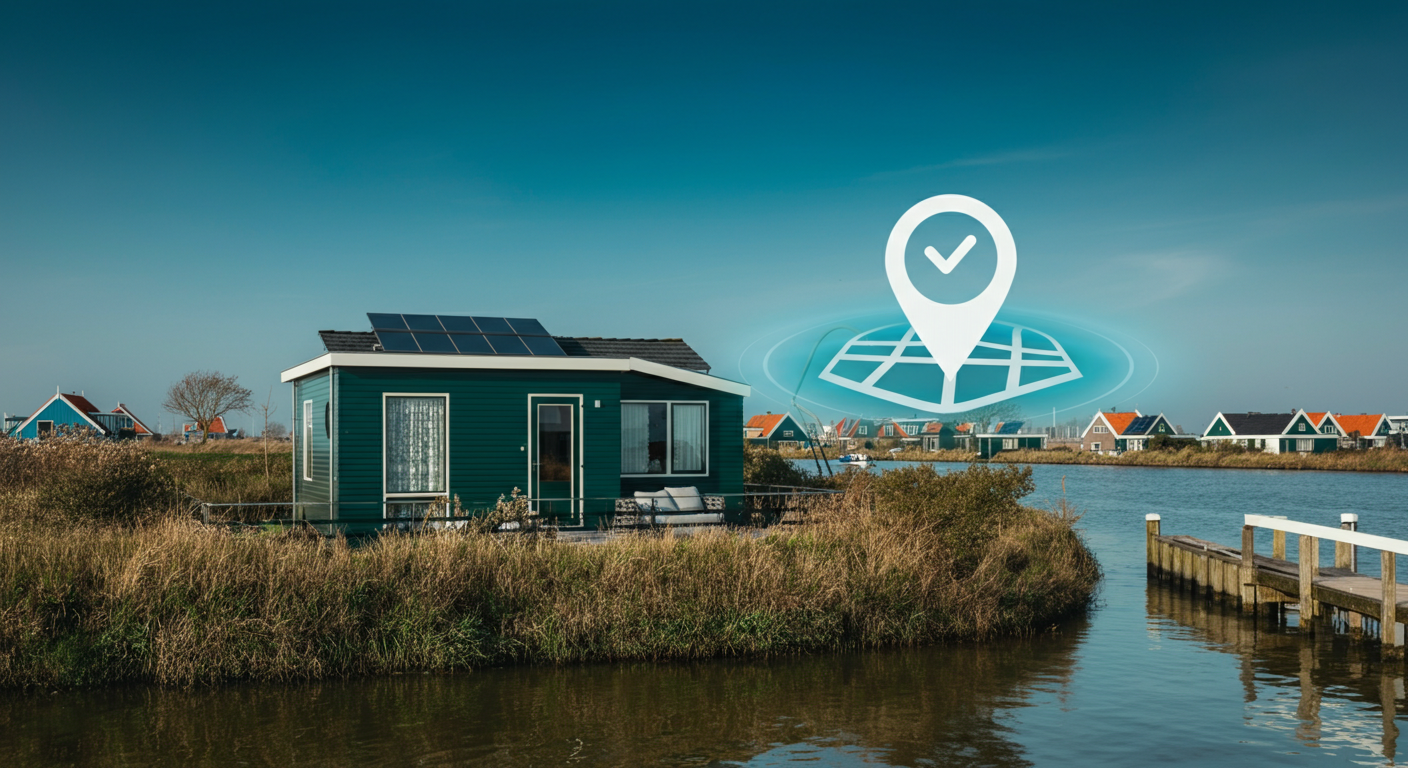
Every summer, the same story repeats. A family books a holiday cottage in Zeeland or the Ardennes through a listing on Marktplaats or an unfamiliar booking site, pays a deposit, and arrives to find the property does not exist, has already been rented to someone else, or looks nothing like the photos. Holiday rental fraud is seasonal, large-scale and entirely preventable.
Photo geolocation offers a direct line of defence: if the exterior photos in a listing do not match the given address, something is wrong.
Why holiday rental fraud works so well
Fraudsters exploit the combination of time pressure and distance. Holiday properties are booked weeks or months in advance, at a location the tenant has never visited. There is no opportunity to drive by and confirm the property exists. Payment via bank transfer is non-reversible. And platforms with large user bases, such as private Facebook groups, offer little verification of sellers.
The listings themselves look convincing. Fraudsters copy photos from real holiday properties, often taken from Booking.com, Airbnb or the website of a legitimate rental agency. They write a credible description, name an attractive price, and create urgency by claiming multiple people are interested.
The Dutch Digital Fraud Hotline (Meldpunt Digitale Oplichting) receives a peak in reports every spring. Individual losses range from a few hundred euros to several thousand euros for families booking an entire house for a week.
How photos are the weak link
The photos in a fraudulent listing are always stolen. That is simultaneously the weakest link in the scheme.
When a fraudster copies photos of a beach villa in Domburg and claims the property is in Renesse, the exterior photos are locatable. The facade, the garden, the street profile, the surrounding buildings: all of these elements contain location signals that correspond to reference imagery at street level.
GeoPin analyses exterior photos and returns the most likely coordinates. If those coordinates differ by hundreds of metres or kilometres from the listed address, the listing is almost certainly fraudulent.
A practical example
Suppose a listing offers a holiday home at the Oude Haven in Veere for 950 euros per week. The listing contains four photos: two of the facade, one of the garden, and one of the inner courtyard.
A verification platform or observant renter sends the facade photo to GeoPin. The system returns coordinates placing the property in Bergen op Zoom, 65 kilometres from Veere. Confidence score: 0.87. The listing is fake.
Without photo geolocation, an average renter would not distinguish this listing from a genuine one. With photo geolocation, the discrepancy is visible within two seconds.
How platforms can use this
Booking platforms and comparison sites can integrate the GeoPin API into their listing validation workflow. The approach is straightforward:
Step 1: Address geocoding. The stated address of the holiday property is converted to coordinates. This is standard functionality that every platform already performs for map display.
Step 2: Photo geolocation. Exterior photos of the property are submitted to the GeoPin API. The system returns the predicted location and a confidence score.
Step 3: Distance comparison. The platform compares the predicted location with the stated address. Large discrepancies trigger a verification warning.
Step 4: Human review or blocking. Depending on the thresholds, a platform can automatically block listings with large discrepancies or forward them to a moderation team.
The API call takes less than ten seconds per photo. For a platform receiving hundreds of holiday property listings daily, this is a scalable check that dramatically reduces the fraud surface.
What individual renters can do
Platforms are not always quick to adopt new verification technology. In the meantime, individual renters can take steps to verify photos before paying.
The most accessible method is reverse image search via Google Images or TinEye. Submit the exterior photo and check whether the same image appears elsewhere. If the photo turns up on another site with a different address, that is a clear signal.
For those who want to go further: the GeoPin API is available via geopin.nl for individual use. Upload an exterior photo of the advertised holiday property and compare the returned location with the address in the listing. A mismatch of more than 500 metres for a property in an urban area is a strong indicator of fraud.
The broader context: platform responsibility
There is growing pressure on platforms to take greater responsibility for listing quality. The Digital Services Act now requires large platforms to act against illegal content, including fraudulent listings. But small and medium-sized platforms fall outside the strictest obligations and are often the primary venue for holiday rental fraud.
Photo geolocation offers a proportionate technical measure: cheap, scalable and effective against the most common form of evidence manipulation. Platforms that adopt it reduce their liability risk and build trust with their users.
The summer of 2026 gives platform operators the opportunity to act this year. Fraudsters are not waiting for next season.
GeoPin provides photo geolocation specifically optimised for the Netherlands and surrounding regions. Read the API documentation or learn more about how GeoPin works.